304 vs 316 vs 310 Stainless Steel Conveyor Belts: Which Grade Do You Need?
When specifying a stainless steel wire mesh conveyor belt, the grade of steel you choose determines everything that matters in service: how long the belt lasts, how it performs at temperature, whether it can withstand your cleaning chemicals, and ultimately what it costs over its lifetime. Yet the differences between grades are frequently misunderstood, and the wrong choice — selecting 304 where 316 is needed, or using 316 where 310 is required — leads to premature failure, unplanned downtime, and higher total cost.
This guide explains the practical differences between 304, 316, and 310 stainless steel for conveyor belt applications: what is in the alloy, what that means in service, and how to match the grade to your specific operating conditions.
What Makes Stainless Steel “Stainless”?
All stainless steels achieve their corrosion resistance through chromium. When chromium content exceeds approximately 10.5%, it reacts with oxygen in the air to form a thin, stable chromium oxide layer on the surface — the so-called passive layer. This layer is self-repairing: scratch it, and it reforms in the presence of oxygen within hours.
The grades most commonly used in wire mesh conveyor belts — 304, 316, and 310 — are all austenitic stainless steels. Austenitic steels are non-magnetic (in their annealed state), highly formable, and excellent at retaining ductility at both low and elevated temperatures. They form the backbone of food processing, pharmaceutical, and industrial conveyor applications worldwide.
What differentiates them is the precise blend of chromium, nickel, molybdenum, and other elements, each of which modifies corrosion resistance, strength, or high-temperature performance in distinct ways.
Grade 304: The Universal Workhorse
Composition
| Element | Typical Content |
|---|---|
| Chromium (Cr) | 18–20% |
| Nickel (Ni) | 8–10.5% |
| Carbon (C) | ≤ 0.08% |
| Iron (Fe) | Balance |
304 is the most widely produced stainless steel in the world, sometimes called “18/8” after its nominal chromium and nickel content. It offers an excellent combination of corrosion resistance, formability, weldability, and cost.
Performance Characteristics
Corrosion Resistance: 304 performs well in most mildly corrosive environments — freshwater, many organic acids, most food products, and standard atmospheric conditions. Its passive layer is robust under neutral and mildly acidic conditions.
The critical limitation of 304 is its susceptibility to chloride-induced pitting and crevice corrosion. In environments containing chloride ions — seawater, salt-based brines, chlorinated cleaning solutions, or even sweat from handling — 304 can develop localised pits beneath the passive layer. Once pitting starts, it progresses rapidly and cannot be stopped without replacing the affected material.
Temperature Performance: 304 is rated for continuous service up to approximately 750°C. Above this temperature, a phenomenon called sensitisation becomes relevant: carbon migrates to grain boundaries and combines with chromium, depleting the passive layer locally and making the steel susceptible to intergranular corrosion. For conveyor belts operating in furnaces or heat treatment applications, this is the practical ceiling for 304.
At the other extreme, 304 maintains ductility and toughness at cryogenic temperatures (down to -196°C), making it suitable for IQF freezer and liquid nitrogen applications.
Hygienic Properties: 304’s smooth, non-porous surface does not harbour bacteria, absorbs no moisture, and withstands standard food-industry CIP (clean-in-place) cleaning agents — provided those agents are not chloride-heavy. It meets the requirements of most food safety standards, including those referenced by the FDA and EU food contact materials legislation.
Best Applications for 304 Stainless Steel Conveyor Belts
- General food processing: baking, cooling, pasteurising, blanching
- IQF spiral freezers and tunnel freezers
- Pharmaceutical tablet conveying and drying
- General industrial conveying in non-chloride environments
- Heat treatment up to approximately 700–750°C
When 304 Is Not the Right Choice
- Environments with chloride-containing cleaning agents (e.g., sodium hypochlorite at high concentrations)
- Coastal or marine environments where airborne chloride is present
- Applications requiring continuous operation above 750°C
- Processes involving contact with strong acids or concentrated salt solutions
Grade 316: Upgraded Corrosion Resistance for Demanding Environments
Composition
| Element | Typical Content |
|---|---|
| Chromium (Cr) | 16–18% |
| Nickel (Ni) | 10–14% |
| Molybdenum (Mo) | 2–3% |
| Carbon (C) | ≤ 0.08% |
| Iron (Fe) | Balance |
316 is frequently described as the “marine grade” or “acid grade” stainless steel. Its defining characteristic is the addition of 2–3% molybdenum, an element that dramatically improves resistance to chloride-induced pitting and crevice corrosion. Nickel content is also higher than 304, further stabilising the austenitic structure.
The Role of Molybdenum
Molybdenum does not form part of the passive layer itself, but it stabilises and reinforces it — particularly in reducing environments and in the presence of halide ions such as chlorides. In practical terms, 316 can withstand significantly higher chloride concentrations before pitting initiates. This makes it the standard choice wherever chloride exposure is a realistic risk.
A useful rule of thumb: if your process or cleaning regime involves any of the following, consider 316 over 304 as a baseline:
- Regular use of sodium hypochlorite (bleach) at working concentrations
- Contact with seawater, salt brine, or pickled products
- Processing of seafood, dairy products, or fermented foods
- Coastal or offshore plant locations with airborne salt
- Contact with phosphoric acid, formic acid, or acetic acid
316L: The Low-Carbon Variant
316L is the low-carbon version of 316 (carbon ≤ 0.03% versus ≤ 0.08% for standard 316). The reduced carbon content minimises sensitisation during welding — an important consideration when belt edges are welded in manufacture. For most conveyor belt applications, 316 and 316L are functionally interchangeable in service; 316L is preferred where extensive welding is involved.
Temperature Performance
316 is rated for continuous service up to approximately 800°C — modestly higher than 304, primarily due to the higher nickel content. The molybdenum addition provides minimal benefit above 500°C, where oxidation rather than chloride attack becomes the dominant degradation mechanism. For high-temperature applications above 800°C, neither 304 nor 316 is adequate, and the 300-series high-temperature alloys (310 and above) must be used.
Best Applications for 316 Stainless Steel Conveyor Belts
- Seafood processing (shrimp, fish, crab) where salt brine is present
- Dairy processing (cheese, yoghurt, whey)
- Ready-meal and convenience food production with aggressive CIP regimes
- Pharmaceutical manufacturing with chloride-containing process fluids
- Chemical processing plants with mild acid or chloride exposure
- Coastal and offshore food or industrial plants
304 vs 316: Is the Upgrade Worth It?
316 typically costs 20–30% more than 304 for equivalent wire mesh belt specifications, reflecting the cost of molybdenum and additional nickel. In many food processing environments where chloride exposure is low and cleaning agents are well-controlled, 304 performs identically to 316 and the premium is not justified.
However, when chloride attack does occur, the cost of unplanned belt replacement — including production downtime, cleaning, and change-over labour — almost always exceeds the original cost premium of specifying 316 from the start. The question to ask is not “can I afford 316?” but “what is the cost if 304 fails prematurely?”
Grade 310: High-Temperature Performance Above 800°C
Composition
| Element | Typical Content |
|---|---|
| Chromium (Cr) | 24–26% |
| Nickel (Ni) | 19–22% |
| Carbon (C) | ≤ 0.25% |
| Iron (Fe) | Balance |
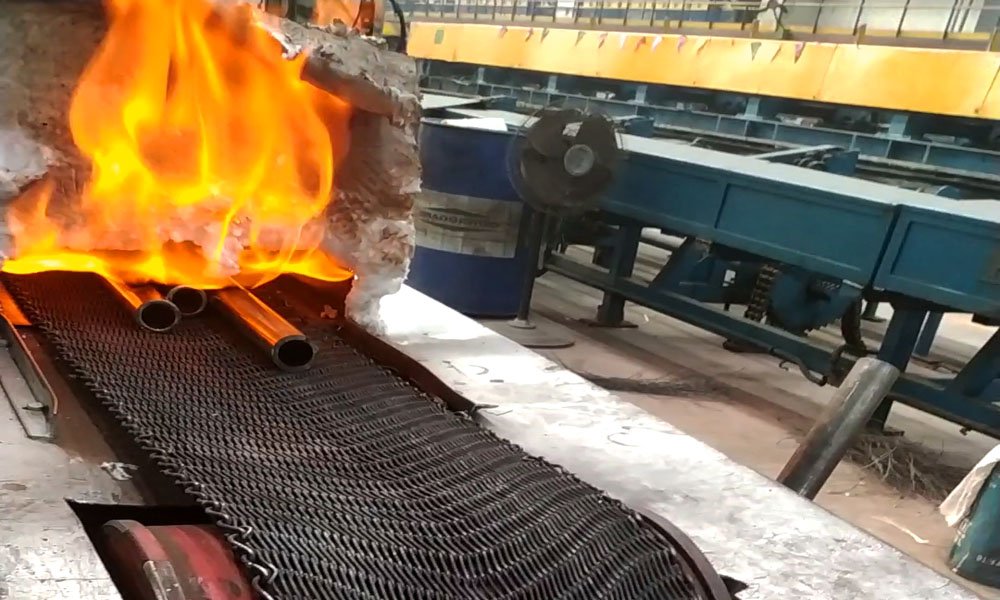
310 is a fundamentally different grade from 304 and 316. It is not primarily selected for corrosion resistance at ambient temperature — it is selected for its ability to withstand continuous oxidising and reducing atmospheres at temperatures between 800°C and 1,100°C.
The key is its much higher chromium content (24–26%) and substantially elevated nickel content (19–22%). These elements combine to form a thick, tenacious chromium oxide scale on the surface that resists oxidation, carburisation, and sulphidation at temperatures that would rapidly destroy lower-alloy grades.
Why High-Temperature Performance Requires a Different Approach
At temperatures above 800°C, the corrosion mechanism is no longer aqueous electrochemical attack — it is gas-phase oxidation. Oxygen, sulphur, carbon, and nitrogen in the furnace atmosphere react directly with the metal surface. The key to resistance is forming a stable, adherent oxide scale quickly and maintaining that scale through thermal cycling.
Chromium oxide (Cr₂O₃) is the most effective protective scale in the 800–1,100°C range. At 24–26% chromium, 310 forms this scale reliably. At 18% chromium (304) or 16–18% chromium (316), the scale is thinner and less stable, and spallation during thermal cycling exposes fresh metal to further attack — leading to rapid wastage.
Nickel serves a different role at high temperature: it stabilises the austenitic structure and prevents the formation of brittle sigma phase, which can form in high-chromium steels cycled repeatedly through the 600–900°C range.
Temperature Performance
310 is rated for continuous service up to 1,100°C in oxidising atmospheres, with intermittent tolerance to approximately 1,150°C. For comparison:
| Grade | Max Continuous Service Temperature |
|---|---|
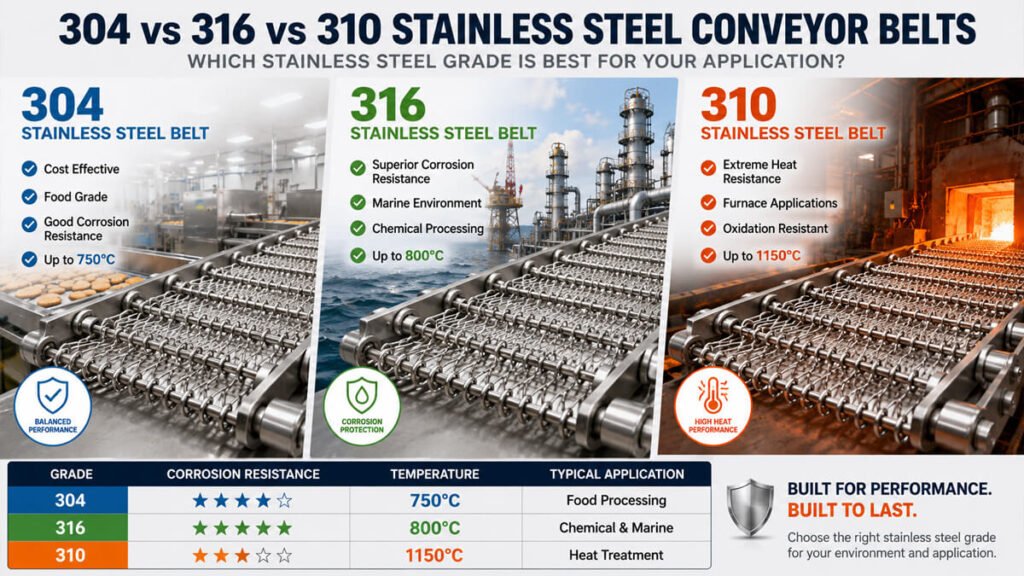
| 304 | ~750°C |
| 316 | ~800°C |
| 310 | ~1,100°C |
What 310 Gives Up vs 304 and 316
310 is significantly more expensive than either 304 or 316 — typically 3–5× the cost of 304 for equivalent wire dimensions. It also has lower ductility at ambient temperature, making the initial wire forming and weaving process more demanding.
Importantly, 310 offers no advantage over 304 or 316 in ambient-temperature corrosion resistance. Its higher chromium provides good general resistance, but the absence of molybdenum means it is not chloride-resistant. Specifying 310 for a food processing application to get “better” corrosion resistance is incorrect — 316 is the right choice there.
Best Applications for 310 Stainless Steel Conveyor Belts
- Continuous belt furnaces for heat treatment (hardening, tempering, annealing)
- Brazing and sintering furnaces
- Glass annealing lehrs operating above 800°C
- Ceramics firing conveyors
- Atmosphere-controlled furnaces for powder metallurgy
- Elevated-temperature processing in the automotive and aerospace supply chain
Side-by-Side Comparison
| Property | 304 | 316 / 316L | 310 |
|---|---|---|---|
| Chromium content | 18–20% | 16–18% | 24–26% |
| Nickel content | 8–10.5% | 10–14% | 19–22% |
| Molybdenum | None | 2–3% | None |
| Max continuous temp | ~750°C | ~800°C | ~1,100°C |
| Chloride resistance | Moderate | Good | Moderate |
| Cryogenic suitability | Excellent | Excellent | Good |
| Food grade suitability | Yes | Yes (preferred) | Not applicable |
| Relative cost (wire mesh belt) | 1× | 1.2–1.3× | 3–5× |
| Primary selection reason | General use, cost-effective | Chloride / aggressive CIP | High-temperature furnace use |
Beyond 310: When Even Higher Temperatures Are Required
For applications above 1,100°C — or where 310 shows premature oxidation due to cyclic thermal loading or aggressive reducing atmospheres — the next step up involves speciality alloys:
314 Stainless Steel (24–26% Cr, 19–22% Ni, 1.5–3% Si): The silicon addition improves oxidation resistance slightly, rated to approximately 1,150°C.
35/19 and 80/20 Nickel-Chrome Alloys: Nickel-base alloys rather than iron-base, offering service to 1,150°C with superior creep resistance.
Inconel 600 and Inconel 601: Nickel-chromium alloys with aluminium addition (in the case of 601) for outstanding oxidation resistance. Inconel 601 is rated to 1,200°C and is the standard choice for the most demanding continuous high-temperature conveyor applications. These alloys cost significantly more than 310 — typically 8–12× the cost of 304 — but are the only reliable option above 1,100°C.
Practical Selection Guide
Use this decision framework when specifying a stainless steel wire mesh conveyor belt:
Step-1: Determine operating temperature
- Below 750°C → 304 or 316 are candidates
- 800°C–1,100°C → 310 is required
- Above 1,100°C → Inconel 601 or equivalent
Step-2: Assess chloride exposure (for sub-750°C applications)
- No chlorides, neutral cleaning agents → 304 is sufficient
- Chloride-containing cleaning agents, seafood, dairy, coastal location → specify 316 or 316L
Step-3: Consider the economic trade-off
- For long production runs in critical applications, the cost premium of upgrading one grade (304 → 316, or 316 → 310) is almost always recovered through extended belt life and reduced downtime
- For short-life test installations or non-critical conveyors, the base grade may be appropriate
Step-4: Confirm with your belt manufacturer
- Provide full details of operating temperature (minimum and maximum), cleaning regime, product contact, and any known chemical exposure
- A reputable manufacturer will confirm the appropriate grade and advise on edge type, drive method, and mesh specification to optimise total service life
Frequently Asked Questions
Is 316 stainless steel always better than 304?
No. 316 is better than 304 specifically in environments with chloride exposure. In neutral or mildly acidic environments without chlorides, 304 and 316 perform similarly, and 304 is the more economical choice.
Can I use 304 stainless steel in a food processing plant?
Yes, in most cases. 304 meets food safety and hygiene requirements for most food processing applications. However, if your cleaning regime uses high-concentration bleach (sodium hypochlorite) or if your products contain significant salt, 316 is the safer specification.
What stainless steel grade is used for IQF spiral freezers?
304 and 316 are both used in spiral freezer belts. 304 is most common for fresh food applications. 316 is specified where the product or cleaning chemistry creates chloride risk, or for seafood applications. Both grades maintain ductility and structural integrity at cryogenic temperatures.
Why doesn’t 310 have molybdenum if it’s a premium grade?
310 is designed for high-temperature gas-phase environments, where molybdenum provides no benefit — and can actually reduce oxidation resistance above 900°C. The high chromium and nickel content of 310 serves a completely different purpose from the molybdenum in 316. They are not competing grades; they solve different problems.
Can I replace a worn 310 belt with 304 to save money?
Not safely if your application requires 310. Using 304 in a 310 application will result in rapid oxidation, carburisation, and belt failure. The correct grade must be matched to the operating environment.
How do I know which grade my existing belt is?
Visual inspection is unreliable — all three grades look identical. A portable XRF (X-ray fluorescence) analyser can identify the grade non-destructively in under a minute. Alternatively, provide the original purchase documentation to your belt manufacturer.
Conclusion
Choosing between 304, 316, and 310 stainless steel for a wire mesh conveyor belt is not about selecting the “best” grade — it is about matching the right alloy to the specific demands of your application.
304 is the cost-effective default for the majority of food processing, pharmaceutical, and moderate-temperature industrial applications where chloride exposure is controlled.
316 adds molybdenum-enhanced chloride resistance, making it the correct specification for seafood, dairy, aggressive CIP regimes, and coastal environments — at a modest cost premium that is almost always justified by longer belt life.
310 is a fundamentally different alloy designed for continuous high-temperature service above 800°C, where oxidation resistance rather than aqueous corrosion resistance is the governing requirement.
Getting this decision right at the specification stage — rather than discovering the wrong grade through premature failure — is one of the most straightforward ways to reduce the lifetime cost of your conveyor system.
Saryee Belting manufactures balanced weave conveyor belts in all three grades — 304, 316/316L, and 310 — as well as 314 stainless steel, nickel-chrome alloys, and Inconel 601 for the most demanding high-temperature applications. Belt widths from 100 mm to 5,000 mm, with fully custom mesh specifications. Contact us for a technical consultation or quote.